

If you are closing on a home in North Texas this August, you are doing something most buyers do not think about: you are purchasing during the most punishing stress test a house will face all year. The Texas summer does not just make the closing process uncomfortable — it actively exposes every weakness in a home’s structure, mechanical systems, and envelope that mild spring weather quietly conceals.
For buyers in the Sunset, Wichita Falls, Decatur, Bowie, and Nocona areas, the combination of extreme heat, Blackland Prairie clay soil, and the relentless demand placed on aging infrastructure creates inspection findings that simply do not exist in April or October. A qualified home inspector North Texas buyers can trust does more than check boxes during August closings. They read a house under load — the way you will actually live in it.
Here is what the summer heat reveals, and why it matters before you sign at the closing table.
What the August Heat Does to a North Texas Home
When outdoor temperatures in the Wichita Falls and Sunset region routinely climb above 100 degrees, a home’s mechanical systems face a continuous, full-capacity demand that no other season replicates. This is important for buyers because systems that appear functional in a spring inspection can reveal clear performance problems when inspected in August.
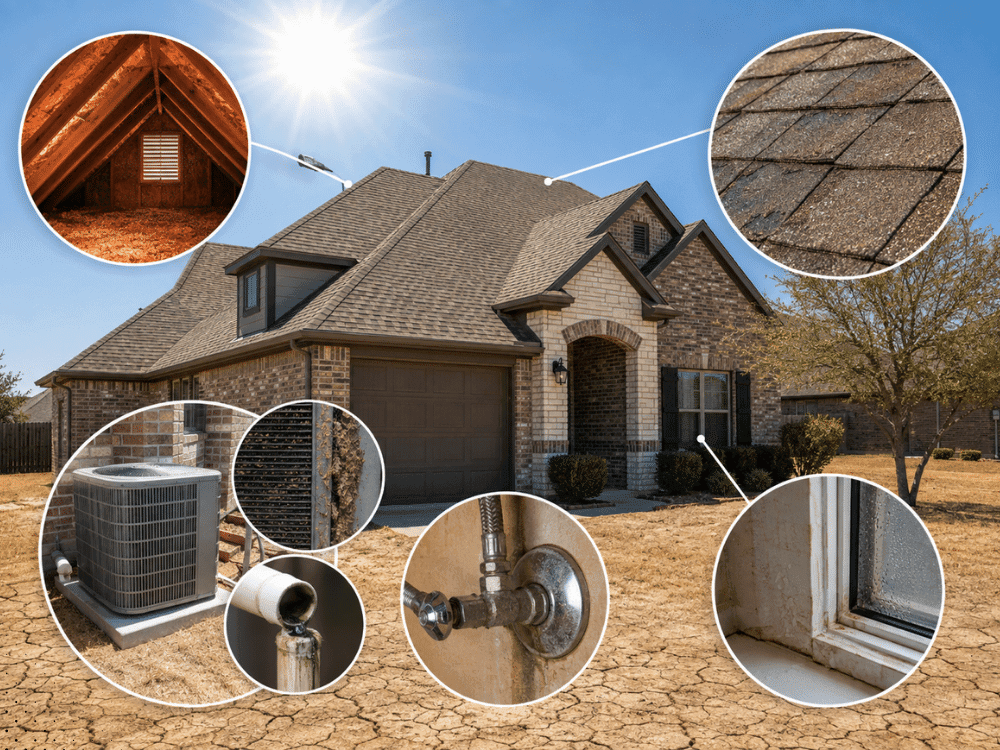
HVAC performance under peak load. A central air conditioning system in North Texas is not just a comfort appliance — it is a life-safety system. During a summer inspection, a qualified inspector can evaluate whether the system is actually delivering adequate cooling under real-world August conditions, not just cycling on and off at 75 degrees in March. An HVAC system that struggles to maintain a 15-to-20 degree differential between indoor and outdoor temperatures on a 103-degree day is telling you something the spring buyer never heard: the system is undersized, degraded, or both. In a region where summers are long and electric bills are significant, a struggling HVAC system is not a minor note — it is a major cost driver that belongs front and center in your negotiation.
For buyers who want a closer look at HVAC performance and temperature variations throughout the home, a Thermal Imaging Inspection can provide additional information about areas that may not be visible during a standard visual evaluation.
Attic temperature and insulation performance. In North Texas summers, attic spaces commonly reach temperatures between 140 and 160 degrees Fahrenheit. At those levels, your inspector is not just checking for insulation depth — they are evaluating whether the attic is adequately ventilated, whether radiant barriers are functioning, and whether the heat load bearing down on the ceiling plane is being managed or transferred directly into your living space. Inadequate attic insulation in this climate is not a comfort issue. It is a cost issue, measured in hundreds of dollars annually on your utility bill.

Clay Soil and Foundation Movement: North Texas’s Hidden Summer Risk
The Sunset, TX area sits on soils that contain a significant proportion of expansive clay — the same Blackland Prairie formation that runs through much of North Texas. Clay soil expands when wet and contracts when dry. After a summer like the ones this region regularly experiences, with stretches of weeks without meaningful rainfall and ground temperatures at extremes, that clay shrinks dramatically.
What does that mean for a house? Foundation movement. Pier-and-beam and slab foundations in clay-heavy North Texas soil are in a constant cycle of expansion and contraction tied directly to soil moisture. An August inspection — when the soil is at peak dryness — gives your inspector a clear picture of how a home responds to worst-case foundation stress. Doors that stick or swing open on their own, gaps at window frames, diagonal cracking at drywall joints, and separation at interior trim are all findings your inspector evaluates in this context.
This does not mean every foundation concern is a crisis. It means buyers need an inspector who understands North Texas soil behavior well enough to distinguish between normal seasonal movement and progressive structural distress. Those are two very different conditions with very different price tags.
A detailed Buyer’s Inspection helps document visible foundation conditions, major systems, drainage, and other components of the property so buyers have a clearer understanding before closing.
What North Texas Inspectors Find in Summer That Sellers Hope Goes Unnoticed
August inspections in homes throughout the Sunset, Bowie, and Nocona markets consistently surface a predictable set of findings — ones that are much easier to overlook during cooler months or when systems are not running at full capacity.
Deferred HVAC maintenance. Dirty coils, clogged condensate drain lines, and low refrigerant are all more apparent when a system is running continuously. A condensate drain that backs up in August can cause ceiling water damage within days. Your inspector checks for these conditions during normal operation of the system — exactly the load it will face every day you live in the home.
Roof and attic ventilation deficiencies. North Texas summers accelerate shingle degradation, particularly on south- and west-facing roof planes. An inspector evaluating a roof in August, when surfaces have been absorbing full summer sun for months, can identify granule loss, blistering, and early-stage weathering that may not yet be visible from the street but will shorten the roof’s remaining life significantly.
Buyers purchasing newly built homes or properties still covered under builder warranties may also benefit from a Builder Warranty Inspection to identify visible construction concerns before warranty periods expire.
Plumbing expansion issues. Water supply lines and fixture connections expand with temperature. Hairline cracks and minor connection looseness that cause no issue in winter can begin to seep under summer thermal expansion. Your inspector checks accessible plumbing for evidence of moisture, staining, and active or prior leaks — findings that an August inspection is uniquely positioned to surface.
Window and door seal failure. Thermal expansion and contraction over years of North Texas summers degrades caulk, weatherstripping, and glazing seals. Your inspector notes these conditions, which have direct implications for both energy efficiency and moisture intrusion.
Questions Sunset Home Buyers Ask About Inspections
Q: How is a home inspection in North Texas different in summer compared to spring or fall?
A: A summer home inspection in North Texas evaluates systems under real peak-load conditions — HVAC running continuously at over 100 degrees, attic spaces at extreme temperatures, and clay soil at maximum seasonal shrinkage — revealing performance and structural issues that spring or fall conditions cannot replicate. Buyers closing in August get a stress-tested picture of the home, not a mild-weather snapshot.
Q: Can a home inspector tell me whether the HVAC system is adequate for a North Texas summer?
A: Yes. A qualified home inspector evaluates the air conditioning system under operating conditions, checks the temperature differential between supply and return air, inspects the coils and condensate drain, and notes whether the system is visibly undersized or struggling to maintain comfortable conditions during the inspection — information that is only fully available when outdoor temperatures are at summer peak.
Q: What foundation issues are most common in Sunset, TX and the surrounding North Texas area?
A: Homes in the Sunset and Wichita Falls area sit on clay-heavy soil that contracts significantly during dry summers, causing slab and pier-and-beam foundations to shift seasonally. Common findings include sticking doors, drywall cracking at corners, and gaps at window frames — conditions your inspector evaluates to distinguish normal seasonal movement from progressive structural damage that requires further engineering review.
Q: How hot does an attic get in a North Texas home in August, and why does it matter?
A: Attics in North Texas homes commonly reach 140 to 160 degrees Fahrenheit in August. At those temperatures, inadequate insulation depth, poor ventilation, and the absence of a radiant barrier all transfer heat directly into the living space, driving up cooling costs and reducing HVAC system life. Your inspector assesses attic conditions and documents deficiencies that directly affect your long-term operating costs.
Q: Should I waive the inspection to compete in the North Texas market?
A: Waiving a home inspection in any market transfers complete risk to the buyer. In North Texas summer conditions, where HVAC systems, foundations, roofs, and attic insulation are all under peak seasonal stress, an uninspected purchase means the buyer accepts all deferred maintenance, system degradation, and structural movement findings without any knowledge of their scope or cost. A home inspection typically costs a fraction of one undiscovered repair.
Schedule Your North Texas Home Inspection Before You Close
Be Informed Inspections serves buyers and sellers throughout North Texas — including Sunset, Wichita Falls, Decatur, Bowie, and Nocona. If you are under contract this summer and need a home inspector who understands what August heat reveals about a North Texas home, the right time to schedule is now — not after you have questions at the closing table.
Give us a call at (972) 827-2366 or schedule your home inspection online at:
https://beinformedinspections.com/schedule/
We deliver thorough, same-day reports so you have the information you need to close with confidence.